
Dissertation vs Thesis: What’s the Difference?
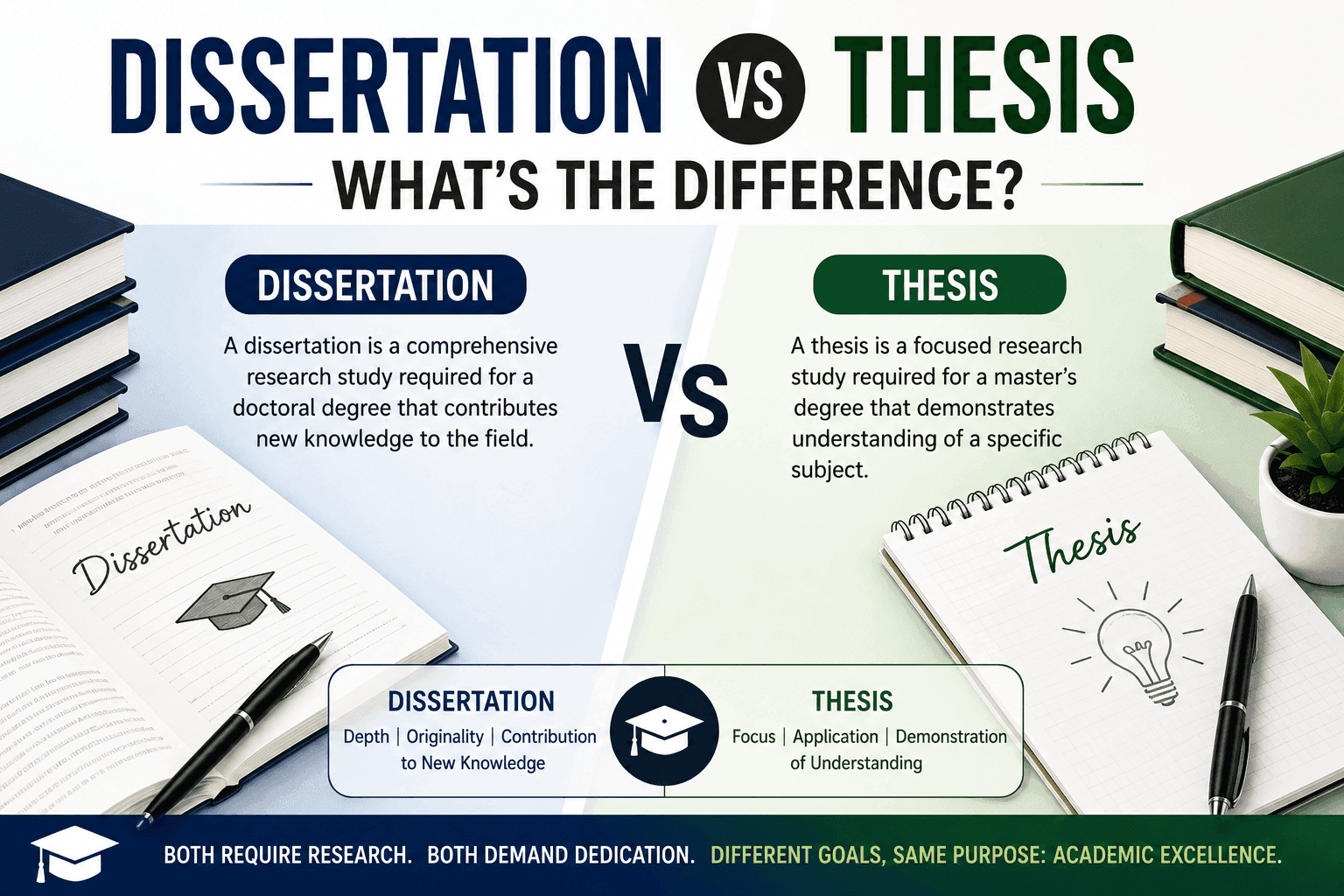
The difference between a dissertation and a thesis depends on the country’s academic system, but in most cases, a thesis is a research project completed during a master’s degree, while a dissertation is a more extensive, original research project required for a doctoral degree. Understanding this distinction is essential because universities use these terms differently, and submitting the wrong type of research project can affect academic requirements, expectations, and evaluation criteria.
For students pursuing higher education in a new academic environment, the confusion between a dissertation and a thesis is common. Universities across different countries often apply these terms in opposite ways or assign different levels of research depth to each. This guide breaks down the key differences, requirements, and expectations so you can quickly determine which project applies to your degree program and academic institution.
What Is a Thesis?
A thesis is a major academic paper in which students show their knowledge, analysis, and application of the knowledge in a particular area. The term is often used differently across educational systems in different countries.
What Is the Purpose of a Thesis in Demonstrating Academic Competence?
A thesis demonstrates a student’s ability to critique previous research, identify areas for further exploration, and develop a logical argument supported by evidence. Frequently, students write about existing scholarship, offering new interpretations or applications, but not developing a completely original theory.
What Are the Elements of a Thesis?
A thesis includes a literature review, research methodology, findings, discussion, and conclusion. Usually, the focus is on demonstrating mastery of a subject area rather than producing groundbreaking findings.
How Does a Dissertation Differ?
In general, a dissertation is considered an advanced form of research, especially at the doctoral level. It is not only a demonstration of knowledge, but also an attempt to create new knowledge.
Why Is Originality Central to a Dissertation?
In a dissertation, students are expected to investigate questions that have not yet been fully answered. The research must add something original to the scholarly debate, something that is new, whether it be in terms of data, method, or theory.
How to Make the Research Process More Independent?
Dissertation research is more likely to involve designing studies, overcoming unexpected obstacles, and independently defending methodological choices, as opposed to structured coursework projects. This is one of the reasons why dissertations are regarded as the highest form of academic research training.
How Is a Dissertation Evaluated?
A dissertation is evaluated not only for its quality but also for its contribution to knowledge within the discipline. Often, examiners ask whether the work contributes to the advancement of knowledge.
What Challenges Make Dissertation Research Unique?
Tackling Uncertainty in Learning
Usually, thesis projects are better defined. Dissertation writers need to learn to live with uncertainty and may not get answers right away.
Maintaining Independence and Supervision
Guidance is provided to doctoral students, but it is their responsibility to guide their research direction. This independence can be the challenge that is most central to the dissertation process.
Establish a Research Identity
A dissertation often represents a student’s first opportunity to develop an independent scholarly voice. This is a pivotal academic change from learner to contributor.
What Are the Differences Between the Two in Terms of Research Strategies?
Creating a Thesis from Discussions that Already Occur → A thesis must be based on a specific research question, and it must be related to existing scholarly debates. The students should focus on clear conclusions, excellent literature analysis, and practice. Students seeking thesis-writing support often find that narrowing the scope of their topic leads to more focused and manageable research.
Creating a Dissertation around Knowledge Gaps → Dissertation planning typically begins differently. Researchers should identify unanswered questions and justify why they deserve further investigation. This includes a lot of preliminary reading before a final research direction is selected.
Managing Time Differently
- A thesis usually has a familiar time structure in relation to the work that must be done in the course.
- Dissertation research may take several years and necessitate a flexible approach to planning and regular review of objectives.
Data Handling and Evidence of Learning
Thesis projects are often based on a small amount of data and a few case studies. Dissertation research is often broader in scope, more time-intensive, and more complex to conduct.
Where Do Students Get Confused?
Many students become confused because some educational systems use the terms “thesis” and “dissertation” differently.
The American Perspective
Students usually write a thesis when earning a Master’s degree and a dissertation when earning a doctorate in the United States.
The British and European Perspective
In the United Kingdom and parts of Europe, a dissertation is used for undergraduate and master’s research projects, and a thesis is used for doctoral-level research.
Why Does Terminology Matter?
While the terminology can vary, the expectations that come with the project are what matter. Students should focus on what their institution actually requires rather than relying on international terminology.
How Do Universities Around the World Approach These Projects?
Expectations and assessment practices are both impacted by global academic cultures.
- North America
Original research, committee review, and formal defences are highly valued in North American institutions. Students who need help structuring their dissertations often explore dissertation writing services for guidance on research organization, formatting requirements, and project planning. However, the dissertation itself must ultimately reflect the student’s own research, analysis, and scholarly contribution.
- United Kingdom
British universities tend to place a strong focus on strict methodology and self-managed research planning. Vivas are usually long oral examinations that are part of a doctoral exam.
- Australia and New Zealand
Research in these countries often combines both theoretical and applied approaches. Collaborations are becoming more common in the industry.
- Asia
Research output at many Asian universities has increased significantly over the past decade. In several institutions, it is increasingly expected that students have to publish articles before graduation.
- Middle East and Emerging Academic Markets
For the construction of research ecosystems in developing countries, it is usual to merge international standards with local research priorities, which aim to solve regional problems and opportunities.
Key Considerations for Students When Choosing a Project
Is the Research Question Sustainable?
Students need to consider something other than the final product before they start writing. The best research topics remain engaging and relevant months after the project begins. Passion for a topic can make a huge difference in persistence through challenging times.
Are Resources Available?
Early evaluation of access to participants, databases, archives, or laboratory facilities should be considered. Even strong research ideas can become impractical if the necessary resources are unavailable.
What Defines Academic Success?
Students need to know from the beginning what will be assessed. Personal interest alone may not be enough to satisfy academic requirements.
Is There Room for Improvement in the Process Through External Guidance?
Yes. The external guidance can help with the dissertation process in a way that makes it easier and more structured, with effective planning strategies. With resources like Dissertation Ace, students can better organize their work and manage their time, while still taking full responsibility for the research, analysis, and writing required to produce an original dissertation.
FAQs
Is a dissertation necessarily longer than a thesis?
Yes, in most educational systems. However, length varies according to degree level, discipline and university. Generally, contribution and quality are more important than word count.
Which is more challenging, a dissertation or a thesis?
While a thesis usually concentrates on evaluating previous research, a dissertation is actually seen as more difficult since it necessitates fresh research and a substantial contribution to knowledge.
Can a thesis ultimately be used as a topic for a dissertation?
Indeed. Many PhD candidates expand concepts from their master’s thesis into more thorough and unique research endeavours.
Conclusion
Understanding the differences between a thesis and a dissertation helps students choose the right research approach and meet their institution’s academic expectations. While a thesis allows students to engage critically with existing knowledge, a dissertation allows them to expand knowledge by conducting original research from scratch. This means the required skills, research strategies, and expectations differ, and following them is also important to present your work that actually stands out.

I help postgraduate students navigate the most demanding part of their academic journey. From refining research questions to polishing final chapters, I provide structured support that keeps projects moving forward through my blogs and guides.